

Briefings about Kobbie Mainoo wanting to leave Manchester United on loan have come out in the last few days and counter-briefings, as well as interview quotes from Amorim emphasise the point: ‘Kobbie needs to stay and fight for his place.’
On the face of things this appears logical and fair. Fans have made comments in reference to a supposed poor mentality for not wanting to stick it out and make that position his own. I get it from their perspective but it misses key context.
Superficially, Amorim has spoken about how Mainoo is competing with captain Bruno for that specific position. In a very basic way, this partly explains why Mainoo playing many minutes becomes less likely, especially in a one-game-a-week season.
More importantly analysing Amorim’s game model more closely makes it all the more apparent why Mainoo, irrespective of his quality, irrespective of his performances and irrespective of how hard he trains, may struggle to make that position his own if this system in its current version persists.
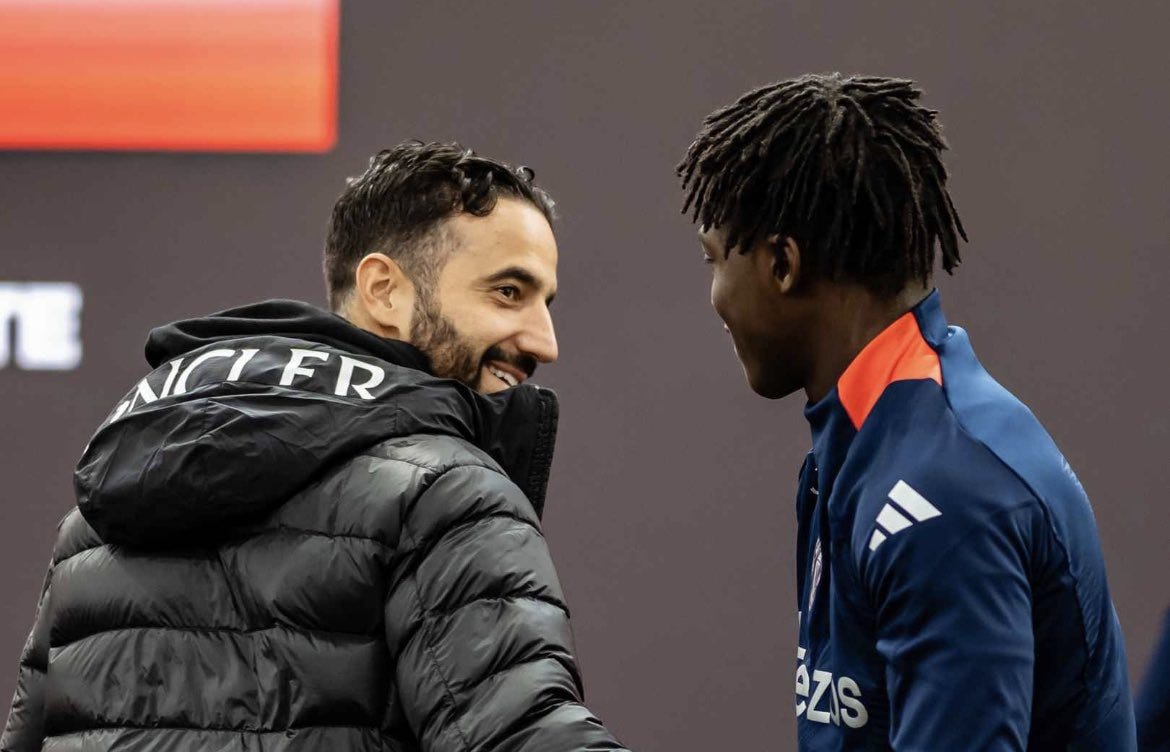
Let’s touch upon Amorim’s game model briefly.
I elaborate on it in more depth for a tactical deep-dive for BBC Sport that comes out tomorrow.
Anyways, a non-exhaustive list of Amorim’s principles for the purpose of illustrating my point:
• A positional system, not possessional – players stay in their given areas of the pitch but Amorim does not stress the need to dominate the ball and play slow the entire game. Players don’t rotate much into other zones although we’ve seen more glimpses of this since pre-season.
• A focus on building down the flanks.
• A focus on overloading various parts of the pitch, namely the wide areas.
• A system that asks for repeatable, almost-choreographed passing circuits to be performed, often with minimal touches in midfield – this is often in the form of a vertical direct pass up the pitch followed by a layoff before the third player plays a lofted through ball to a wingback or attacker running in behind. (When you begin to notice this, you’ll see it everywhere).
• The above scheme aims to bait the opponent’s defensive line to step up when the first pass goes into the forward player (who has dropped deep).
• The lofted through ball aims to find a runner who then can cut the ball back for attackers in the box, after this artificial transition situation has been created. United try to force that direct through ball very often under Amorim.
When you understand these things (and there’s more, we’ve not touched on, particularly the out of possession stuff) then you begin to understand why Amorim makes the personnel decisions he does.
Again I elaborate on this in the BBC piece tomorrow.
So what does this mean for Mainoo?
The passing circuit described above is sometimes called an up, back, through in the coaching world mirroring the movement of the ball in the scheme — a pass up the pitch, a lay off backwards, and a through ball.
The midfielder is central to this circuit.
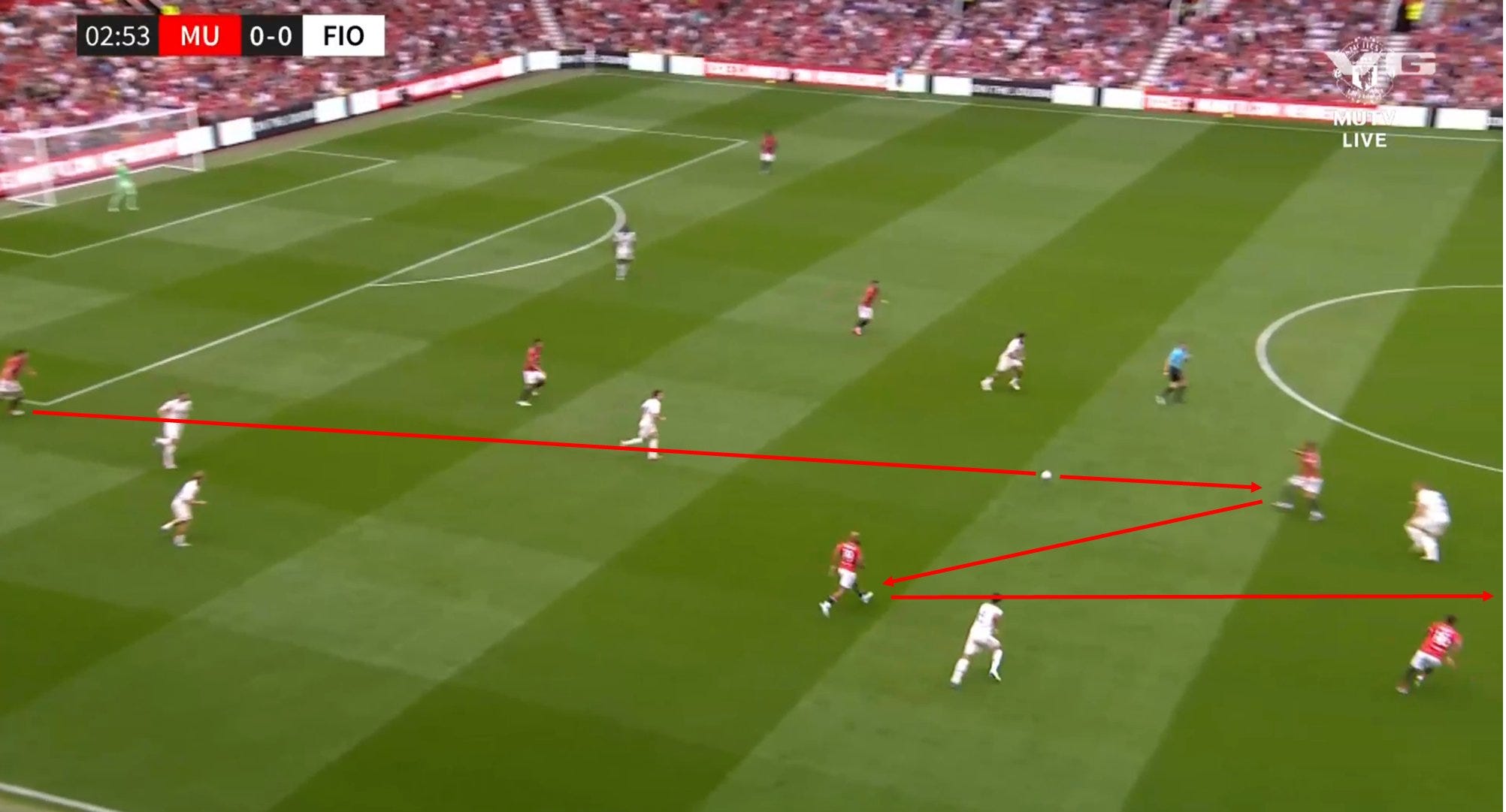
On the ball they’re often asked to play with fewer touches, aiming to enact some of these passing patterns. Many of the passes that an Amorim central midfielder ‘should’ play are longer, more direct ones.
Off the ball they’re asked to cover big distances, attempting to back up the attackers running in behind as well as running back to defend big spaces when the ball is lost.
Amorim is fairly rigid to his system. He has a very specific image for each role and doesn’t alter his system to accommodate the player quality at his disposal. He wants players to work to fit his demands.
Mainoo is a brilliant footballer, one of the best young midfielders in football and his involvement for the national team as a teenager in knockout football is a testament to that.
What he isn’t is a big space runner, who thrives playing with very few touches, used as a slingshot to launch balls over the top.
Mainoo is a wonderfully talented connector between multiple players in smaller spaces, he thrives taking numerous touches, drawing pressure and shrugging nearby defenders off him. He takes his team up the pitch slowly and contributes to goals around the box.
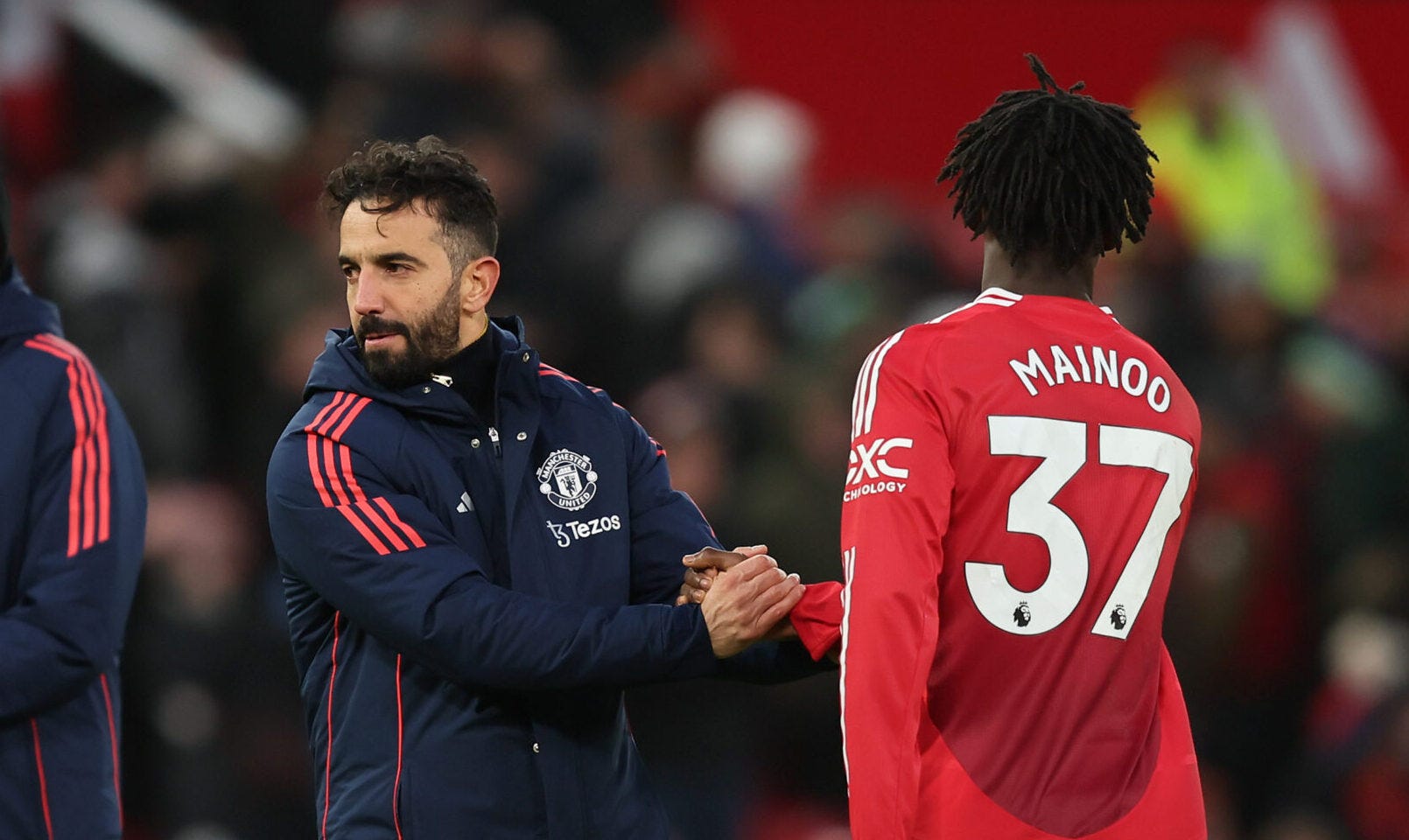
It becomes easier to see the mismatch in player and role here.
Kobbie Mainoo’s innate way of seeing and playing football is inherently not what Amorim wants in his version of the central midfielder at present.
My brief summary of what an Amorim midfielder is helps explain why Bruno Fernandes and Casemiro are the first choice pair. Think about what they offer comparatively. Hard running, minimal touches, direct vertical passes over the top, duelling quality.
Irrespective of how hard Mainoo tries to adapt to become this style of Amorim midfielder and even if he does decently well at it, it may more broadly be a misuse of his biggest strengths unless Amorim tweaks his game model to get Mainoo in areas he suits, being encouraged to play his natural game.
Fight or hard work won’t necessarily change that.
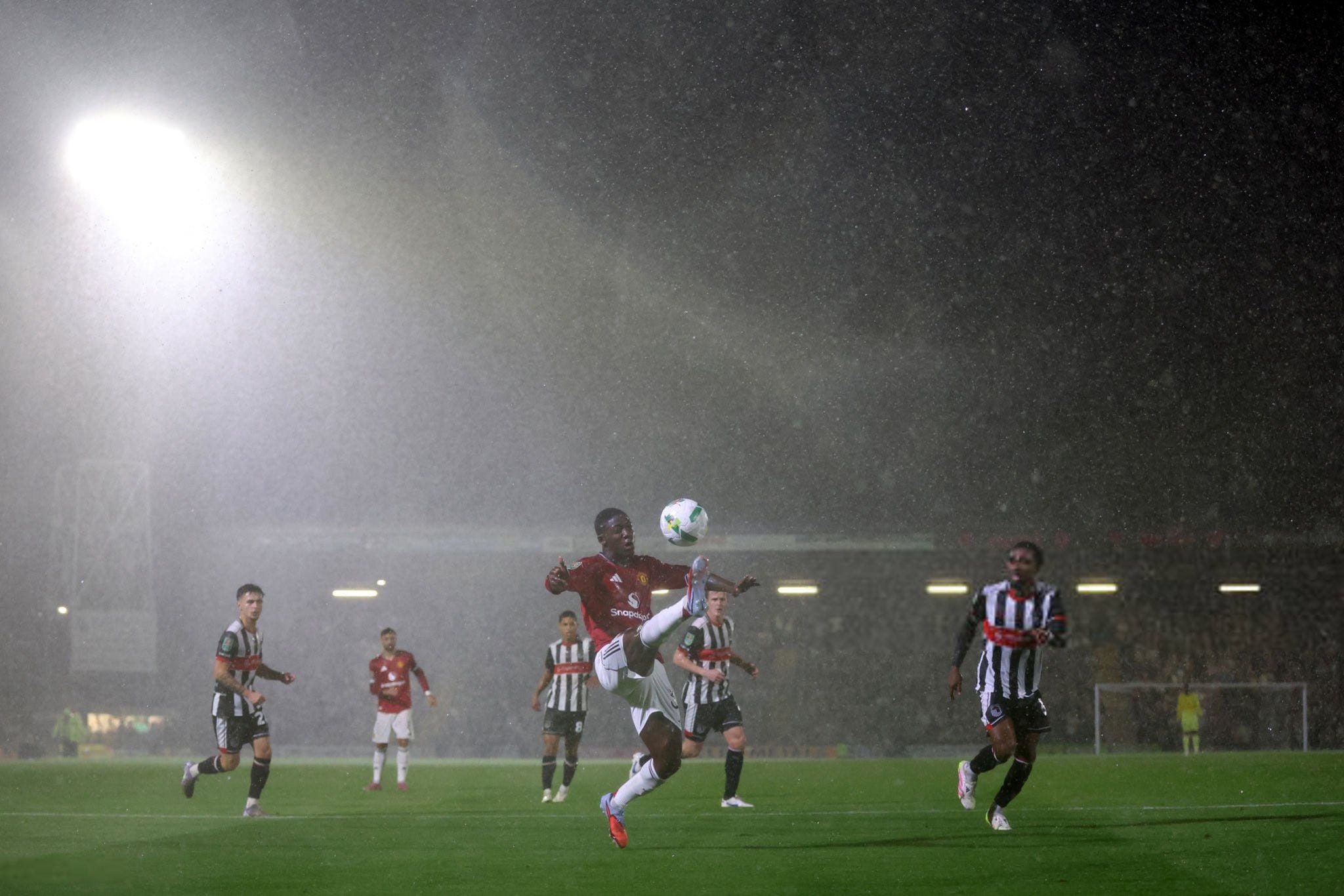
Against Grimsby, Mainoo showed individual quality going against some of the Amorim automatisms and passing routines often used. He took extra touches, dribbled more, and disrupted the League Two sides man to man press.
Although this was functionally beneficial, I wonder what Amorim thought seeing successful actions that stray from his broad tactical instructions.
If he insists on having his midfielder play a specific way, there is potential for Mainoo expressing his natural game to be the source of concern for Amorim, even if it does lead to some good attacking moments.
In a World Cup year, being platformed in a way that plays to your strengths, playing weekly maximises your chances of being selected.
For the young midfielder who lit up the Euros as a teenager, missing out on the World Cup this summer would be an unfortunate turn in his so-far promising career.
Dr Umir Irfan, professional football analyst and scout.
📧: contactumirf1(at)gmail(dot)com
Teams change coaches and players every 2-3 years nowadays. If a 20yo cannot adapt to a system and the belief is he can only play in certain types of systems that player is being setup for failure. Mainoo is 20 years old and not set in stone - a great example of this is Baleba who was asked to do very different things by his last 2 coaches and he adapted. Malleability is an important trait for players - especially young ones.
Another thing to consider is the precariousness of Amorim's position. There's no upside to the club for loaning out a player who you might end up needing in 6-8 weeks time and a single injury to Cunha/Mbeumo/Mount (which has now already happened with Cunha/Mount) will drastically shift the team setups and give Mainoo more minutes. Asking him to tough it out and fight is not as unreasonable as many make it seem neither should he be slandered for wanting to leave in the short term. The last and major issue would have beem that if he leaves without signing a contract that effectively ties the clubs hands on selling him if he doesn't want to stay.
These issues are highly complex and have many nuances and fans repeatedly refuse to view them as such, instead picking a view and then advocating solely for that view - which isn't too realistic in the real world.